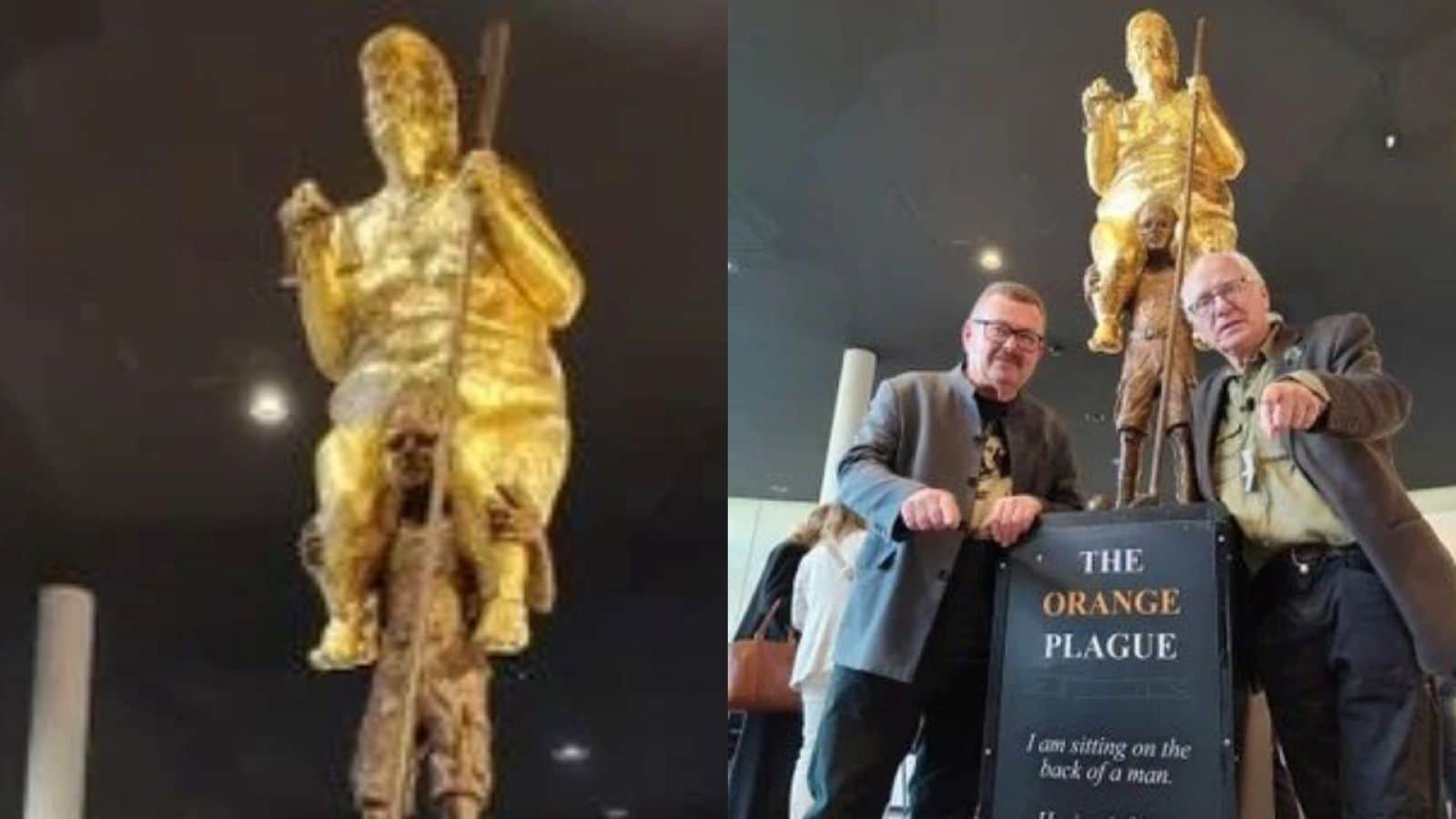
You walk into the European Parliament building in Strasbourg, France, and expect the usual sea of gray suits and dull committee documents. Instead, you stare directly at an 8.2-foot-tall, 23-karat gold-coated sculpture of a naked Donald Trump sitting comfortably on the shoulders of a struggling, smaller bronze man. It is loud. It is bizarre. And it is completely intentional.
Created by Danish artist Jens Galschiøt, the piece is titled "The Orange Plague" (also dubbed "The King of Injustice"). It features Trump holding a small pair of scales of justice and a golf club, perched atop a sinking citizen who kneels beside a small golf-ball-sized globe. Below the sculpture, a satirical plaque reads, "I am sitting on the back of a man. He is sinking under my burden. I will do anything to help him. Except stepping down from his back."
If you dismiss this as mere shock value or cheap political theater, you are missing the entire point of modern protest art. Galschiøt didn't just weld some metal together for a laugh. He built a calculated visual argument about power, climate policy, and global hypocrisy that is currently dominating international headlines.
The Message Behind The Gold
Let’s be honest about what the gold represents. Galschiøt drew direct inspiration from Hans Christian Andersen’s classic fairy tale The Emperor's New Clothes. In that story, an vain emperor walks around completely naked because he is conned into buying invisible garments, while terrified subjects pretend his outfit is stunning out of fear of social exile.
Galschiøt flipped that dynamic on its head. In his version, the emperor isn't just invisible; he is blindingly, garishly visible, coated in expensive 23-karat gold while everyone pretends his policies aren't crushing the people underneath him.
"Now we put the gold on him," Galschiøt explained when discussing the installation, noting that the shiny veneer makes the imagery even more ridiculous. "Trump is shining so much that nobody can see other people."
The timing isn't accidental either. The sculpture arrived in Strasbourg after a stint at the United Nations COP30 climate conference in Brazil, and it is scheduled to travel next to the COP31 climate conference in Turkey. The core critique zeroes in on environmental policy. Critics and organizers argue that the current administration's push to roll back climate commitments, undermine green energy initiatives, and suppress scientific data acts as a heavy boot on the neck of global sustainability efforts.
When you have a superpower leader actively discouraging other nations from pursuing green transitions, the rest of the world bears the weight. That is the exact dynamic the sculpture portrays: a gilded figure playing golf while the ordinary citizen bears the sinking weight of ecological neglect.
Why Political Art Stings So Much
We have seen plenty of satirical statues over the last decade. From giant inflatable chickens wearing golden hair to full-sized nude figures plastered across American cities, artists have tried every trick in the book to puncture political egos. Most of them fade into internet memes within forty-eight hours.
"The Orange Plague" is different because of its venue. Getting an 8-foot naked golden statue inside the official European Parliament building requires institutional sponsorship. In this case, Danish MEP Per Clausen sponsored the exhibit, letting it bypass the usual bureaucratic stonewalling that stops controversial art from reaching halls of power.
When you put protest art directly inside the halls where international laws and policies are debated, you force politicians to walk past the absurdity every single day. You can scroll past a tweet on your phone. You can ignore a headline about a protest in Brazil. But it is a lot harder to ignore a towering, gilded indictment of global policy when you are grabbing your morning coffee in the Parliament lobby.
To amplify the message, Galschiøt didn’t just leave the statue on display and walk away. He brought reinforcements.
The Viral Strategy
If you visit the exhibition in Strasbourg, you don't just look at the art. You walk away with a piece of it. Galschiøt printed roughly 20,000 miniature 3D-printed replicas of the statue, distributing them directly to visitors, tourists, and staff members inside the European Parliament.
Even smarter? He uploaded the design files online for free. Anyone with a 3D printer anywhere in the world can download the blueprint and print their own miniature "Orange Plague" at home.
This decentralized approach changes the rules of engagement for political protest. Governments can ban a physical statue from entering a building, and security guards can confiscate banners, but you cannot stop digital files from spreading across the internet. By open-sourcing the protest, Galschiøt turned a localized art installation in France into a global, peer-to-peer distribution network.
What Happens Next
The statue's run in Strasbourg is short, wrapping up its current legislative display before preparing for its journey to Turkey for the next major UN climate summit. Whether you view the sculpture as brilliant political commentary or childish disrespect, it achieves its primary objective: it forces a conversation that people desperately want to avoid.
Climate policy is dense, boring, and filled with dry bureaucratic jargon that makes most people tune out in thirty seconds. A naked, gold-plated president sitting on the back of a struggling citizen cuts straight through the noise. It turns complex geopolitical friction into an image you cannot unsee.
Stop waiting for politicians to gracefully acknowledge their blind spots. Sometimes it takes an 8-foot lump of gold and a heavy dose of public ridicule to remind everyone who is actually carrying the weight.