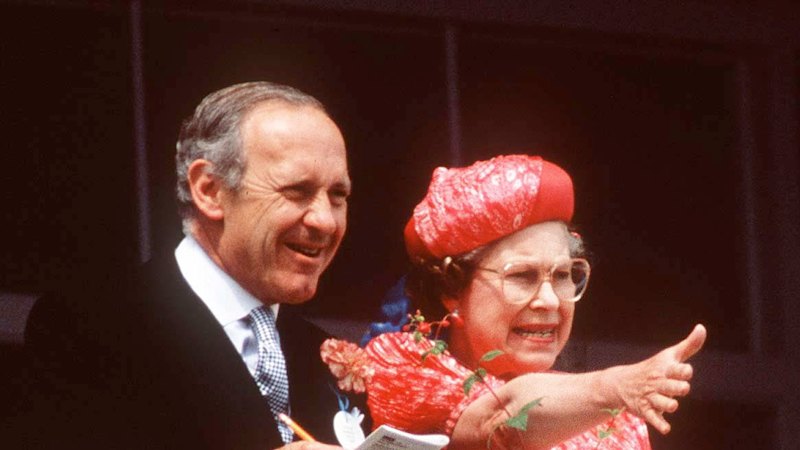
The traditional British court used to be defined by distance, stuffiness, and a fierce aversion to public scrutiny. Then came an Australian-born strategist named Sir William Heseltine, who helped drag the House of Windsor out of the nineteenth century. When Heseltine passed away at the age of 96, he left behind an institution fundamentally altered by his quiet, pragmatic touch. Queen Elizabeth II trusted him so implicitly she called him "my Bill."
If you want to understand how a rigid, media-shy royal family survived the twentieth century, you have to look at the innovations Heseltine engineered. He didn't do it with grand manifestos or loud rebellions. He did it from inside the palace walls, armed with sharp wit, acute political instincts, and a total lack of aristocratic pretension.
The Outsider Who Walked Into the Palace
Born in Fremantle, Western Australia, in 1930, Heseltine was miles away from the elite social circles that traditionally populated royal households. His father was a teacher, and his background was thoroughly middle-class. After graduating from the University of Western Australia, he didn't head straight to London. Instead, he started in the Australian Prime Minister's Department, eventually serving as private secretary to prime minister Robert Menzies.
Working with Menzies taught Heseltine how power actually functioned. Menzies was an imposing, silver-tongued leader who famously tried to correct his young secretary's pronunciation. Heseltine fired right back, correcting Menzies' habit of mispronouncing his own surname. That kind of backbone earned Menzies' respect, and it caught the attention of British palace officials searching for fresh talent from the Commonwealth.
When Heseltine arrived at Buckingham Palace in 1959 as an assistant information officer, he found an operation locked in a defensive crouch. The press secretary at the time, Commander Richard Colville, was universally known as "The Abominable No Man." Colville's strategy for dealing with journalists was simple: slam the door and say nothing.
Heseltine knew that approach was dead on arrival in a changing media landscape. The public wanted access, not silence.
Rewriting the Rules of Royal Engagement
Heseltine's most enduring legacy is the invention of the royal "walkabout." Back in 1970, during a tour of New Zealand, Heseltine and his colleague Philip Moore threw out the playbook. Instead of marching past roped-off crowds with stiff waves, members of the royal family walked directly up to ordinary people, shook hands, and chatted.
Critics thought it was a dangerous populist stunt that risked lowering the mystique of the crown. They were wrong. The walkabout transformed public relations for the monarchy, turning cold distance into faux-intimacy. It became the bedrock of modern royal survival.
Around the same time, Heseltine spearheaded another massive gamble: the 1969 BBC documentary Royal Family. Directed by Richard Cawston, the film invited cameras inside the private lives of the Windsors, capturing them eating breakfast, barbecuing, and relaxing. Sixty-eight percent of the British population tuned in.
While some purists argued it violated Walter Bagehot's famous warning that you must never let daylight in upon magic, Heseltine saw it differently. He understood that obscurity breeds irrelevance. By showing the family washing dishes and cracking jokes, he made them human.
Navigating Crises Without Losing Your Head
Heseltine officially served as the Queen's fifth private secretary from 1986 to 1990, but his influence spanned decades across various press and deputy roles. That tenure wasn't all walkabouts and television specials. He faced ferocious political storms.
In July 1986, The Sunday Times dropped a bombshell report claiming the Queen was deeply at odds with Prime Minister Margaret Thatcher over social policies and Commonwealth stances. It turned out royal press secretary Michael Shea had nudged journalists toward that narrative. Heseltine had to step into the fray, reassure the public, and protect the sovereign's absolute political neutrality.
He also managed sticky international friction, such as handling ousted Fijian leaders seeking royal intervention after military coups. Heseltine politely but firmly kept the crown out of geopolitical quicksand, knowing the monarch's power relies entirely on restraint.
He retired at 60, just before the brutal cascade of scandals in 1992 that the Queen dubbed her annus horribilis. Looking back, Heseltine admitted that if he had known what awaited the family with the marital collapses of her children, he might have stayed longer. Yet the structures he built kept the institution afloat even through its darkest chapters.
What We Can Learn From His Legacy
Most corporate leaders and public figures today still make the classic mistake of hiding behind closed doors when crises hit. They panic, clam up, and hope the noise goes away.
William Heseltine proved the exact opposite strategy works. He knew that transparency—managed carefully and paired with genuine human connection—builds far more trust than ivory-tower isolation. He refused to be intimidated by tradition, and he wasn't afraid to tell powerful people hard truths.
He declined a seat in the House of Lords, turned down high-profile gubernatorial posts, and eventually returned home to Western Australia. He lived out his life quietly, maintaining a private correspondence with the Queen until her death.
The monarchy of today looks the way it does largely because an Australian schoolteacher's son decided that tradition doesn't have to mean stagnation. Next time you see a king or queen shaking hands down a crowded street, remember who put them there.