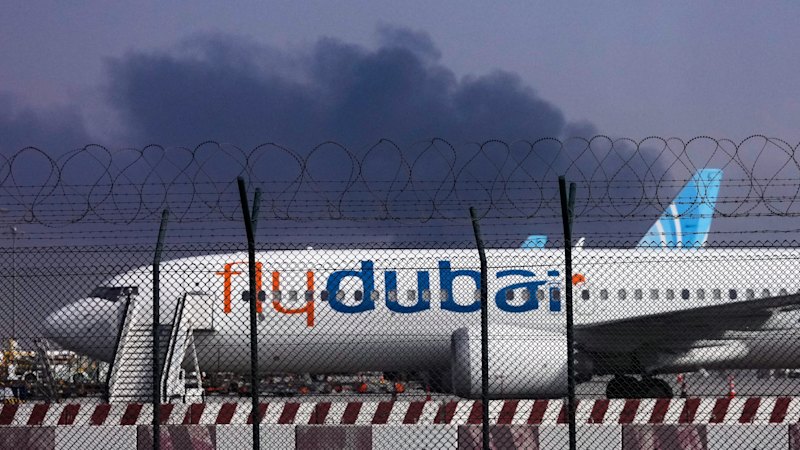
When a commercial pilot turns rogue inside the cockpit, the margin between normal operation and absolute catastrophe vanishes in seconds. Aviation security experts have spent years arguing about vulnerabilities on the flight deck, but few scenarios match the chilling precision uncovered in the aftermath of flydubai Flight FZ1073.
The 29-year-old Omani co-pilot, Hamam al-Hammami, didn't just snap on a whim during a September 30 route from Dubai to Tel Aviv. According to findings released by the UAE state-run news agency WAM and Attorney General Hamad Saif Al Shamsi, al-Hammami booked and flew the exact same route twice beforehand. He wasn't just working his shifts. He was rehearsing an airport attack, familiarizing himself with airspace topography, and planning how to plunge the aircraft into Ben Gurion Airport with maximum lethality.
We need to talk about how modern aviation vetting systems completely miss these insider threats. Let's look at what the investigation exposes, how the mid-air struggle played out, and why rogue crew members remain commercial aviation's most terrifying blind spot.
The Anatomy of a Premeditated Mid-Air Attack
Flying commercial airliners requires strict adherence to protocol, redundant safety systems, and profound trust between crew members. Al-Hammami exploited that foundational trust entirely.
According to official disclosures, his ideological radicalization trace back years, influenced by online propaganda he consumed while studying in Australia around 2017. Before landing a job at flydubai in January 2026, he built a conventional aviation resume, working at Oman Air from 2020 to 2024 and Royal Air Maroc starting in early 2025.
Standard recruitment checks didn't catch him. He held a valid pilot's license, provided a clean certificate of good conduct, and passed all background screenings. The system ticked every bureaucratic box, yet failed to detect an unfolding terrorist plot.
When Flight FZ1073 was underway, al-Hammami executed his plan by attacking Captain Smit Machchhar inside the cockpit. The aircraft abruptly plunged more than 4,000 meters in under 30 seconds—a rate of descent that creates immediate danger for structural integrity and passenger safety.
How Quick Thinking Saved Flight FZ1073
Disaster was averted only due to extraordinary intervention from off-duty crew and passengers.
Another pilot, assigned to the return flight, happened to be sitting in the cabin. He noticed the cockpit door repeatedly opening and closing in an unusual pattern, sparking immediate suspicion. Using the emergency access code, he entered the flight deck just as the violent struggle was unfolding.
Simultaneously, passengers and cabin crew rushed forward to subdue the co-pilot. Working together, they stabilized the aircraft and restrained al-Hammami, allowing the alternate crew to safely divert and land the plane at Tabuk airport in Saudi Arabia. Captain Machchhar sustained stab wounds during the assault but managed to keep his composure alongside the crew to prevent a complete catastrophe.
If that off-duty pilot hadn't noticed the erratic door cycles, the plane would have hit the ground long before anyone inside the cabin realized what was happening. It highlights a recurring truth in aviation safety: human intervention often overrides technological failures.
Why Background Checks Fail Rogue Pilots
The core issue exposed by this incident isn't just about flydubai or Middle Eastern carriers. It is a global vulnerability.
Airlines run background checks, verify licenses, and review police records. They cannot scan a pilot's internal thoughts, private browsing habits on encrypted apps, or radical shifts in personal ideology unless those beliefs manifest in legal convictions or flagged watchlists. Al-Hammami kept his extremist views hidden behind a clean professional exterior.
Security analysts have pointed out that rogue pilots represent an almost impossible threat to completely eliminate. You cannot lock cockpit doors against the person legally assigned to fly the plane. When a co-pilot turns violent, the physical barrier designed to keep intruders out becomes a trap keeping defenders away.
Authorities in the UAE have continued auditing recruitment procedures to see where warning signs might have been missed. Yet, investigators admit that none of the standard pre-employment checks flagged any red flags regarding his intentions.
What This Means for Future Air Travel
Passengers boarding international flights assume extensive multi-layered screening protects them. While airport metal detectors and baggage scanners catch physical weapons smuggled by passengers, they do nothing against a certified crew member carrying out an ideologically motivated attack.
Airlines face difficult choices moving forward. Do they implement mandatory psychological evaluations with high-frequency monitoring? Do they require dual-occupancy rules in the cockpit at all times—meaning a flight attendant must step in whenever a pilot leaves? Many carriers abandoned strict dual-occupancy rules due to operational friction, but incidents like this force a brutal reassessment.
The investigation into al-Hammami's background and confession remains active. Legal proceedings will move forward, but the structural vulnerability inside commercial flight decks remains unaddressed. Trust is the baseline of aviation. When that trust breaks at 35,000 feet, you are left depending entirely on split-second bravery from the people sitting in row twelve.